
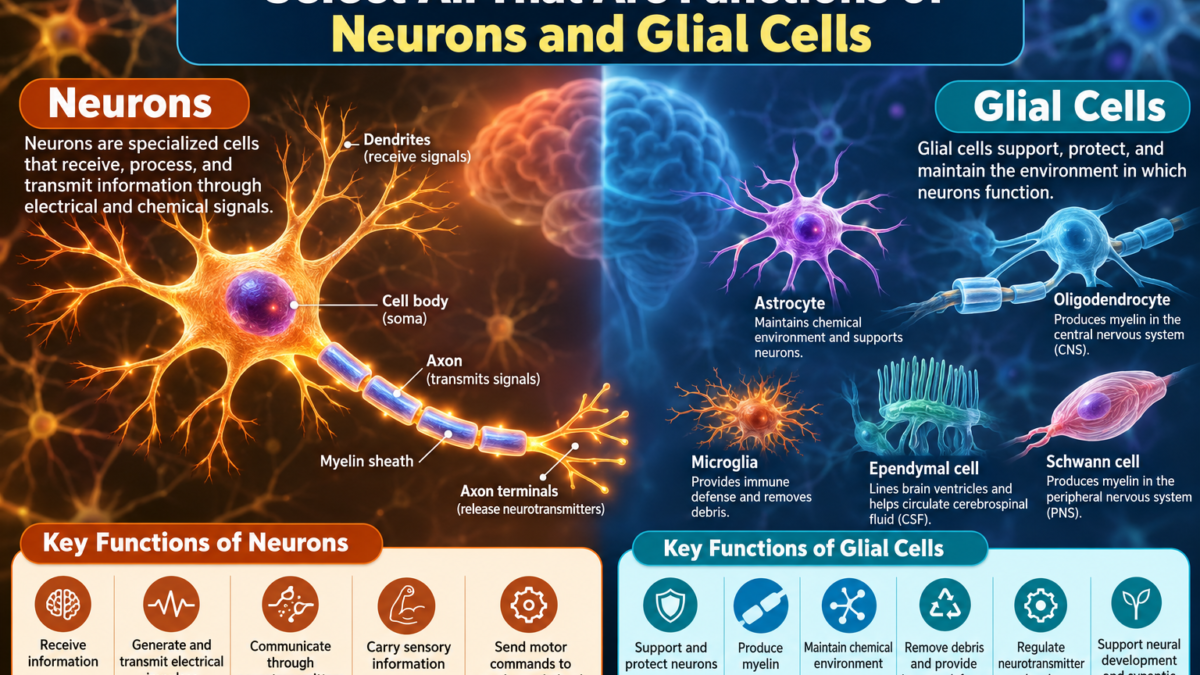
The human nervous system controls everything from thinking and learning to movement, sensation, breathing, and memory. Two essential cell types make these activities possible: neurons and glial cells. Although both are found in nervous tissue, they perform different yet complementary functions that help the brain, spinal cord, and peripheral nerves work efficiently.
If you are studying biology, anatomy and physiology, or neuroscience, you may encounter the question, “Select all that are functions of neurons and glial cells.” To answer it correctly, you must understand how neurons transmit information and how glial cells support, protect, and regulate neural activity.
According to the National Institutes of Health (NIH), neurons receive and transmit information, while glial cells perform several supporting functions, including myelin formation, cellular protection, and regulation of the neural environment.
This guide explains the functions of neurons and glial cells, their differences, their major types, and the correct answers to common biology questions.
What Are Neurons and Glial Cells?
Neurons and glial cells are the two major cell groups found in nervous tissue. They work together to process information, coordinate bodily activities, and maintain healthy nervous system function.
What Are Neurons?
Neurons, also called nerve cells, are specialized cells responsible for receiving, processing, and transmitting information through electrical and chemical signals. They allow the brain to communicate with the rest of the body.
A typical neuron contains three main structural components:
- Cell body (soma): Contains the nucleus and most of the cell’s organelles.
- Dendrites: Receive incoming signals from other neurons or sensory receptors.
- Axon: Carries electrical impulses away from the cell body toward other cells.
At a synapse, neurons commonly communicate by releasing chemical messengers called neurotransmitters. These substances transmit signals to other neurons, muscle cells, or gland cells.
According to OpenStax Anatomy and Physiology, neurons are responsible for the electrical signaling and communication that underlie sensation, movement, and thought.
What Are Glial Cells?
Glial cells, also known as neuroglia, are specialized cells that maintain the environment in which neurons function. Rather than simply acting as structural support, they perform essential roles in nutrition, insulation, immune defense, waste removal, and the regulation of neural communication.
Important functions of glial cells include:
- Supporting and protecting neurons.
- Producing myelin around certain axons.
- Maintaining the chemical environment around nerve cells.
- Removing cellular debris and responding to injury.
- Regulating neurotransmitter levels.
- Supporting neural development and synaptic function.
Research published in Molecular & Cellular Proteomics describes how glial cells also influence synapses, metabolism, blood flow, and the maintenance of ionic and water balance in nervous tissue. Read the scientific review on glial contributions to neural function for further details.
What Are the Main Functions of Neurons?
Neurons perform several functions that enable the nervous system to detect changes, process information, and coordinate appropriate responses.
1. How Do Neurons Receive and Transmit Information?
One of the primary functions of neurons is communication. Sensory receptors or other neurons provide incoming information, which neurons process and transmit through nerve impulses.
An electrical signal called an action potential travels along the axon. At many chemical synapses, the arrival of this signal triggers neurotransmitter release, allowing the message to reach another cell.
This process is essential for communication between the brain, spinal cord, sensory organs, muscles, and internal organs.
2. How Do Neurons Control Movement?
Motor neurons carry signals from the central nervous system to muscles. These signals can trigger muscle contraction, enabling activities such as walking, writing, speaking, and lifting objects.
Motor pathways also participate in reflexes, which help the body respond rapidly to potentially harmful stimuli.
For example, when you touch a hot surface, sensory neurons detect the stimulus and relay information into neural circuits. Motor neurons then help activate the muscles that withdraw your hand.
3. How Do Neurons Process Sensory Information?
Sensory neurons detect stimuli such as pressure, temperature, pain, sound, and other sensory inputs. Specialized sensory receptors convert environmental or bodily changes into signals that the nervous system can process.
The brain interprets these signals to produce sensations and perceptions. This enables you to recognize objects, hear sounds, maintain balance, and respond to changes in your surroundings.
Learn more about the parts and functions of the nervous system through the National Institute of Child Health and Human Development.
4. How Do Neurons Support Thinking, Learning, and Memory?
Neurons form interconnected networks that enable complex brain activities, including reasoning, attention, learning, decision-making, and memory.
Communication between neurons changes as people learn new information. Changes in synaptic strength and neural connections contribute to learning and memory formation.
Therefore, neurons do more than transmit basic sensory signals: they also participate in the information-processing networks responsible for complex behavior and cognition.
What Are the Main Functions of Glial Cells?
Glial cells help create and maintain the conditions necessary for neurons to survive and communicate effectively. Different types of glia specialize in different functions.
1. How Do Glial Cells Support and Protect Neurons?
Glial cells provide structural and physiological support for neurons. They help maintain a stable environment around nerve cells and contribute to the normal functioning of neural networks.
Some glial cells supply metabolic support, while others regulate extracellular ions and neurotransmitters. These processes help prevent excessive changes in the chemical environment that could interfere with neural signaling.
2. How Do Glial Cells Produce Myelin?
Myelin is a lipid-rich insulating layer that surrounds portions of certain axons. It helps electrical impulses travel efficiently along nerve fibers.
Two important myelin-producing glial cells are:
- Oligodendrocytes: Produce myelin in the central nervous system, which includes the brain and spinal cord.
- Schwann cells: Produce myelin in the peripheral nervous system, which includes nerves outside the brain and spinal cord.
Myelin supports rapid and efficient nerve impulse conduction. Damage to myelin can interfere with communication between the brain and body.
The OpenStax explanation of nervous tissue provides an overview of these cell types and their roles.
3. How Do Glial Cells Maintain the Chemical Environment of the Brain?
Astrocytes are star-shaped glial cells found in the central nervous system. They regulate the environment surrounding neurons by helping control extracellular potassium levels, taking up certain neurotransmitters, and supporting metabolic processes.
Astrocytes also contribute to the blood-brain barrier, a specialized interface that helps regulate the movement of substances between the bloodstream and brain tissue.
These functions are vital because neurons depend on carefully controlled chemical conditions to generate and transmit signals.
4. How Do Glial Cells Protect the Nervous System From Injury?
Microglia are the resident immune cells of the central nervous system. They monitor their surroundings and respond to infection, injury, and cellular damage.
When necessary, microglia can remove cellular debris and damaged material through phagocytosis. Their activity also helps regulate inflammatory responses within nervous tissue.
Other glial cells contribute to repair and recovery processes, although the outcome depends on the type and severity of the injury.
5. How Do Glial Cells Help Neurons Communicate?
Glial cells influence neural communication by regulating neurotransmitter uptake, maintaining ionic balance, and helping control synaptic activity.
Astrocytes, for example, remove certain neurotransmitters from the space around synapses. This helps regulate the duration and intensity of chemical signaling.
Glial cells also contribute to synapse formation, maintenance, and elimination. Their activities help neural circuits develop and adapt over time.
Which Types of Glial Cells Are Found in the Nervous System?
Glial cells are commonly classified according to their location and specialized functions.
| Glial cell type | Main function |
|---|---|
| Astrocytes | Maintain the chemical environment, support neurons, and contribute to the blood-brain barrier |
| Oligodendrocytes | Produce myelin in the brain and spinal cord |
| Microglia | Provide immune surveillance and remove cellular debris |
| Ependymal cells | Line the brain’s ventricles and central canal of the spinal cord; some help circulate cerebrospinal fluid |
| Schwann cells | Produce myelin and support axons in the peripheral nervous system |
| Satellite cells | Support neuron cell bodies in peripheral ganglia and regulate their local environment |
These cells work together to maintain nervous tissue and support effective communication between neurons. For a more detailed scientific overview, consult the NCBI Bookshelf chapter on neuroglial cells.
What Is the Difference Between Neurons and Glial Cells?
The key difference is that neurons specialize in information processing and signaling, while glial cells primarily maintain, protect, and regulate the environment needed for neural activity.
| Feature | Neurons | Glial cells |
|---|---|---|
| Primary role | Receive, process, and transmit information | Support, protect, and regulate neural function |
| Electrical signaling | Generate and propagate action potentials in many neuron types | Generally do not communicate through neuronal action potentials |
| Structure | Typically have a cell body, dendrites, and an axon | Have diverse structures depending on their type |
| Myelin production | Axons may be surrounded by myelin | Oligodendrocytes and Schwann cells produce myelin |
| Immune defense | Not their primary role | Microglia provide immune surveillance in the CNS |
| Chemical regulation | Release and respond to neurotransmitters | Help regulate neurotransmitters and extracellular ions |
An important distinction is that glial cells are not merely passive support cells. They actively influence neuronal development, metabolism, synaptic function, and responses to injury.
How Should You Answer “Select All That Are Functions of Neurons and Glial Cells”?
When answering a multiple-select biology question, identify which statements describe neurons, which describe glial cells, and which apply to both.
Correct functions of neurons include:
- Receiving and processing information.
- Generating and transmitting electrical impulses.
- Communicating through neurotransmitters at chemical synapses.
- Carrying sensory information toward the central nervous system.
- Sending motor commands to muscles and influencing gland activity.
Correct functions of glial cells include:
- Supporting and protecting neurons.
- Producing myelin around axons.
- Maintaining the chemical environment surrounding neurons.
- Regulating neurotransmitter levels.
- Providing immune defense and removing cellular debris.
- Supporting neural development and synaptic function.
Functions shared across the nervous system: Neurons and glial cells work together to maintain healthy neural circuits, although they perform different tasks. For instance, neurons transmit signals while glia help maintain the conditions that make reliable signaling possible.
If the question asks specifically about functions performed by both cell types, do not automatically select every statement listed above. Read each option carefully: signal transmission is a defining neuronal function, whereas myelin production is performed by specialized glial cells.
Frequently Asked Questions
1. What is the main function of neurons?
The main function of neurons is to receive, process, and transmit information through electrical signals and chemical communication.
2. What is the main function of glial cells?
Glial cells support and protect neurons, maintain the neural environment, regulate communication, and perform specialized functions such as myelin production and immune defense.
3. Which glial cells produce myelin?
Oligodendrocytes produce myelin in the central nervous system, while Schwann cells produce myelin in the peripheral nervous system.
4. Do glial cells transmit nerve impulses?
Glial cells generally do not transmit information through neuronal action potentials. However, they influence neuronal signaling by regulating neurotransmitters, ions, and synaptic activity.
5. What are the three main parts of a neuron?
The three main parts are the cell body, dendrites, and axon.
6. Why are glial cells important for brain function?
Glial cells maintain the environment neurons need to function, provide metabolic and structural support, protect nervous tissue, and help regulate neural communication.
7. What is the difference between astrocytes and microglia?
Astrocytes primarily support neurons and regulate their chemical environment, while microglia act as immune-surveillance cells that respond to damage and help remove cellular debris.
Conclusion
Neurons and glial cells are essential for the proper functioning of the nervous system. Neurons receive, process, and transmit information, enabling sensation, movement, learning, memory, and other cognitive activities. Glial cells support these processes by producing myelin, maintaining chemical balance, regulating synaptic activity, providing metabolic support, and protecting nervous tissue.
For the question “Select all that are functions of neurons and glial cells,” remember the central distinction: neurons specialize in neural communication, while glial cells maintain and regulate the environment that makes this communication possible. Understanding their individual roles and how they work together makes it easier to identify the correct answers in biology exams and anatomy and physiology assessments.